Keeping Time in a Noisy Market
If 2025 reminded us of anything, it’s how quickly markets can move, and how easily short-term signals can drown out long-term fundamentals. Much of the year felt governed by the minute hand: rapid news cycles, shifting narratives, and sharp factor rotations. Our investment process, by contrast, is guided by the hour hand. It’s steadier, slower-moving, and focused on what compounds value over time.
U.S. equities finished higher for a third consecutive quarter in Q4, supported by resilient earnings growth, 50 basis points of additional Federal Reserve rate cuts, and easing trade tensions. At the same time, investors weighed growing scrutiny around AI investment returns, a softening labor market, and heightened political uncertainty. Despite these crosscurrents, the S&P 500 returned 17.9% in 2025—its 3rd straight year of double-digit gains— though market breadth remained narrow, with fewer than one-third of constituents outperforming the index.
As we close the year, we believe it is a useful moment to step back from the second-by-second movements and reflect on key themes from our 2025 writings that carry relevance and investment implications heading into 2026.
Lessons from 2025
One defining feature of 2025 was historic concentration within U.S. Large Cap indices, a resurgence of speculative behavior down the capitalization spectrum, and a massive wave of AI-driven capital spending. This backdrop challenged our approach, which emphasizes durable business models, strong balance sheets, and reasonable valuations.
In our CIO piece, “What Have I Become”, we discussed how technology sector concentration reached extreme levels at the same time valuations became increasingly elevated relative to the broader market. While premium valuations are often justified by strong growth prospects, one notable consequence has been a reduction in the sector’s defensive characteristics during market drawdowns.
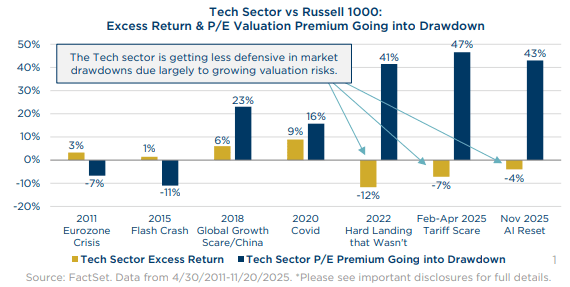
We witnessed evidence of this early in 2025 and then again in Q4, as AI scrutiny mounted. Simply put, price still matters, especially when optimism runs ahead of durability.
We also highlighted the deterioration in quality across many Small- and Mid-Cap indices, where the share of unprofitable, highly leveraged, and expensive companies has risen meaningfully over the past decade. While periods of index concentration have historically preceded market broadening, we believe today’s speculative tilt reinforces the importance of selectivity and active management in these segments.
A third theme, explored in “It’s Déjà Vu All Over Again”, centered on the surge in AI-related capital expenditures. While technological innovation can drive real economic progress, history reminds us that capital cycles rarely produce uniform winners. High returns tend to attract competition, often leading to overcapacity and diminished shareholder outcomes. In that sense, enthusiasm alone is not a sufficient investment thesis, and capital allocation discipline remains critical.
Strategy Recap
Our portfolios began 2025 with strong relative performance, but that advantage faded following the April market bottom as risk appetite accelerated and leadership narrowed. For the full year, our QARP-oriented strategies lagged benchmarks, including our International Equity portfolio. Globally, Quality and Lower-Volatility factors experienced one of their most challenging periods in decades, as markets favored high-beta and speculative exposures.
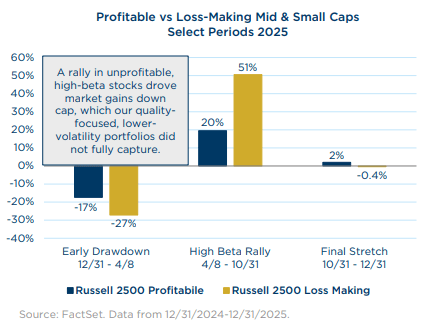
These dynamics were most pronounced in our Mid Cap, SMID, and Small Cap strategies, where volatility spikes were largest. Our Income Equity strategy stood out for much of the year, with strong stock selection offsetting factor struggles, though that advantage diminished late in the year as leadership re-narrowed and Yield headwinds mounted. Upside capture remained broadly in line with expectations, but underexposure to the Top 10 mega caps was the primary source of relative detraction.
While humbling, there were encouraging signs toward year-end. Our Mid Cap, SMID, and Small Cap portfolios outperformed in Q4, as the high-beta rally showed signs of fatigue. As the saying goes, even a broken watch is right twice a day, and history suggests high-beta rallies tend to be fleeting. The last two months of 2025 may mark the beginning of the mean reversion process we’ve seen play out historically time and again.
Importantly, our portfolios continued to demonstrate downside resilience during 2025’s periods of market stress. As we discussed in “The Anatomy of a Long-Term Investor”, compounding is rarely linear. Reflecting on Warren Buffett’s storied career, we highlighted how Berkshire Hathaway’s stock trounced the S&P 500 over the last 30 years, yet the ride was anything but smooth. Even Berkshire underperformed the S&P 500 in nearly half of the rolling 12-month periods. Patience, discipline, and independent thinking are often tested in the short run, but they are essential over full market cycles.
Looking Ahead
It may be crystal ball season, but we don’t pretend to know what 2026 will bring. On the positive side, earnings trends remain constructive, consumers have shown resilience, and ongoing Fed rate cuts combined with fiscal stimulus measures may continue to support growth. At the same time, late-cycle dynamics are becoming more visible. Trade and tariff policy remain fluid, geopolitical risks are mounting, and elevated complacency leaves markets vulnerable to surprise. Further, a top-heavy market raises the stakes that company-specific issues could have broader market implications.
We’re positioned for more than one outcome. With the large cap indexes increasingly concentrated and tech proving less defensive, we believe valuation and true active share—not index-like diversification—will be critical ballasts for portfolios. Our Quality-at-a-Reasonable-Price approach is well positioned for upside participation while providing the differentiation that may matter most if volatility increases or leadership shifts.
As we look ahead, successful investing requires knowing which hand of the clock to watch. The second hand will continue its frenetic pace, the minute hand will swing with sentiment and headlines, but the hour hand of fundamental value moves with patient purpose. In a market calibrated to digital speed and instant feedback, we remain committed to the analog virtues: quality, discipline, and time-tested principles.
As always, we appreciate and highly value the trust you have placed in us.
With the large cap indexes increasingly concentrated and tech proving less defensive, we believe valuation and true active share—not index-like diversification—will be critical ballasts for portfolios.
Original Post
Read the full article here